Graffiti Art #91 — qargo, Brick by Brick
When material tells another story
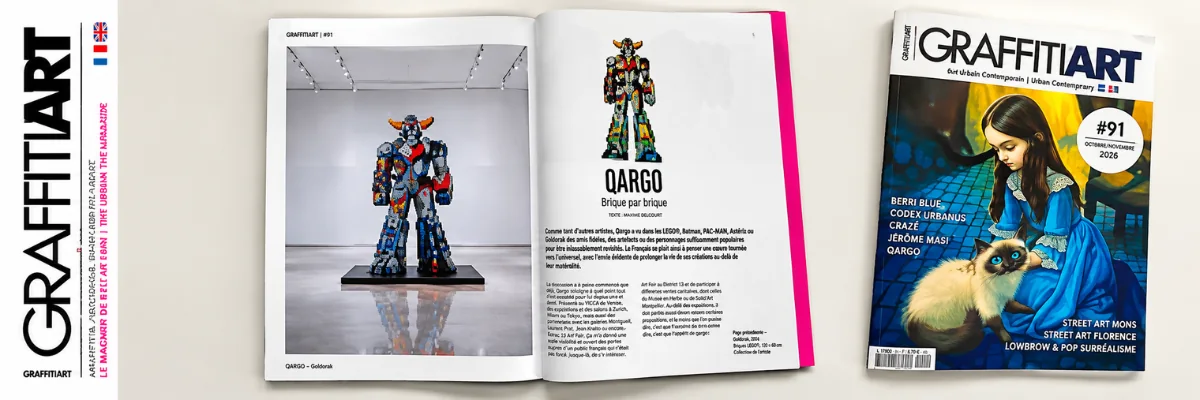
What remains of the original spirit of urban art as its forms evolve, its boundaries dissolve and new visual languages emerge? This question runs through issue 91 of Graffiti Art, devoted to the fertile tension between heritage and reinvention. Within that conversation, the magazine presents qargo’s work in an eight-page portrait, published in French and English and written by Maxime Delcourt.
Entitled “Brique par brique” (“Brick by Brick”), the feature goes beyond introducing an artist and his work. It explores an unconventional journey from entrepreneurship to artistic creation, and a practice built around one intuition: the most familiar objects can become instruments of a new artistic expression. Alongside Berri Blue, Codex Urbanus, Crazé and Jérôme Masi, qargo appears in an issue asking how contemporary art can keep evolving without disowning its influences.
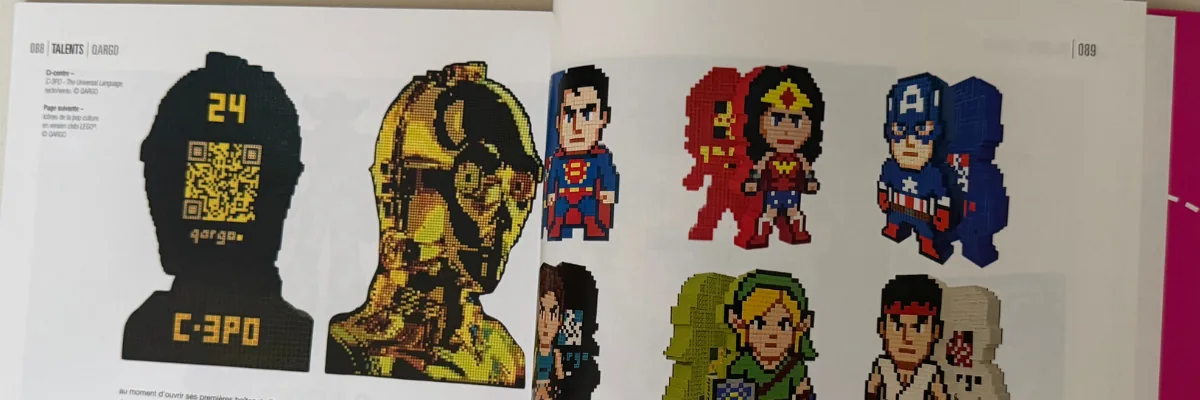
At the heart of his work is a material everyone thinks they know: the LEGO® brick. Associated with childhood, play and construction, it becomes a visual language in its own right. Its geometry imposes constraints, yet opens a field of experimentation where colour, volume and relief form an instantly recognizable signature. Popular-culture figures gain a physical presence that changes with the light and the viewer's perspective.
Characters drawn from popular culture are no longer simply depicted: they acquire a physical presence, density and identity that shift with light and perspective.
This transformation is especially striking in Goldorak Unmasked, whose imposing silhouette opens the feature. Yet behind the immediate visual impact lies a more personal exploration, shaped by memories, figures shared across generations and the ability of certain images to revive emotions we thought forgotten. Popular culture becomes more than a source of inspiration: a collective memory in which everyone may recognize something of their own story.
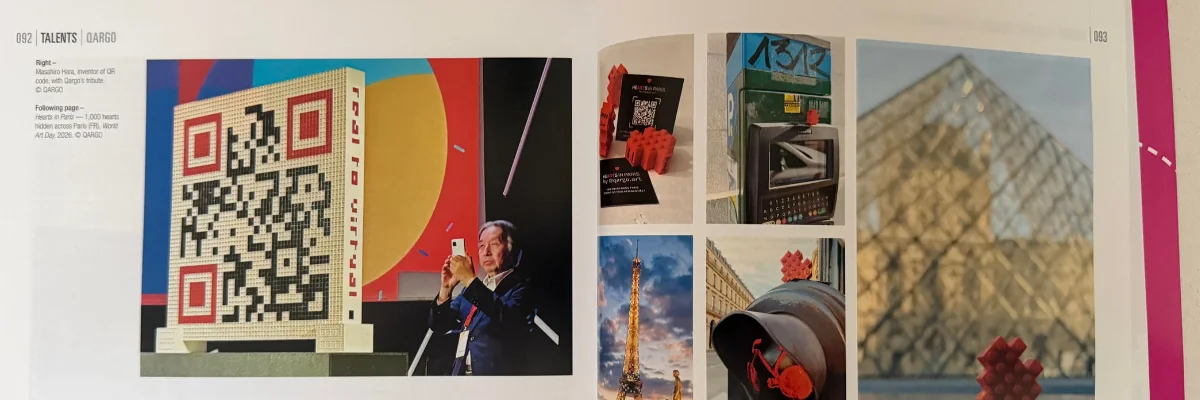
The magazine also explores one of qargo’s most personal signatures: fully functional QR codes, built entirely from LEGO® bricks and integrated into the reverse of his artworks. This discreet element reveals a second dimension, invisible at first glance, where the physical work extends into digital content. It allows the object to tell more than it immediately shows, without ever surrendering its material presence.
This exploration is inseparable from an unusual human story. Through repeated meetings with Masahiro Hara, inventor of the QR code, a genuine friendship has grown, sustained by conversations about a technology that has become universal. That relationship adds another resonance to qargo’s work: behind codes and systems are ideas, individual journeys and encounters capable of transforming an artistic vision.
The same desire to build connections runs through Hearts, a series of interventions in which small LEGO® brick hearts are scattered across public spaces, inviting strangers to discover an artwork by chance. Art leaves its conventional setting and enters everyday life. It becomes a surprise, a gesture, perhaps the beginning of a story whose ending the artist will never know. The encounter itself becomes part of the work.
Through this portrait, Graffiti Art reveals the many dimensions of a practice that refuses to choose between popular culture and artistic rigour, construction and intuition, object and narrative. That freedom to move between worlds speaks directly to the magazine’s central question: how urban contemporary art continues to reinvent itself by exploring unexpected territory.
The publication of these eight pages marks an important step in qargo’s journey. Not because it definitively defines or crowns his work, but because it offers something rarer: the space to consider his practice as a whole, beyond the immediate visual impact of the artworks, and to reflect on what they reveal about our relationship with images, memory and creation.
Behind every brick lies an intention. And behind every image, perhaps another story waiting to be discovered.
The “Brique par brique” portrait appears in Graffiti Art issue 91, October–November 2026, available from the magazine’s official shop.