Wall piece · 2026
Le Figaro — Circulation of Ideas (36)
Artwork by qargo, contemporary visual artist, made of LEGO® bricks.
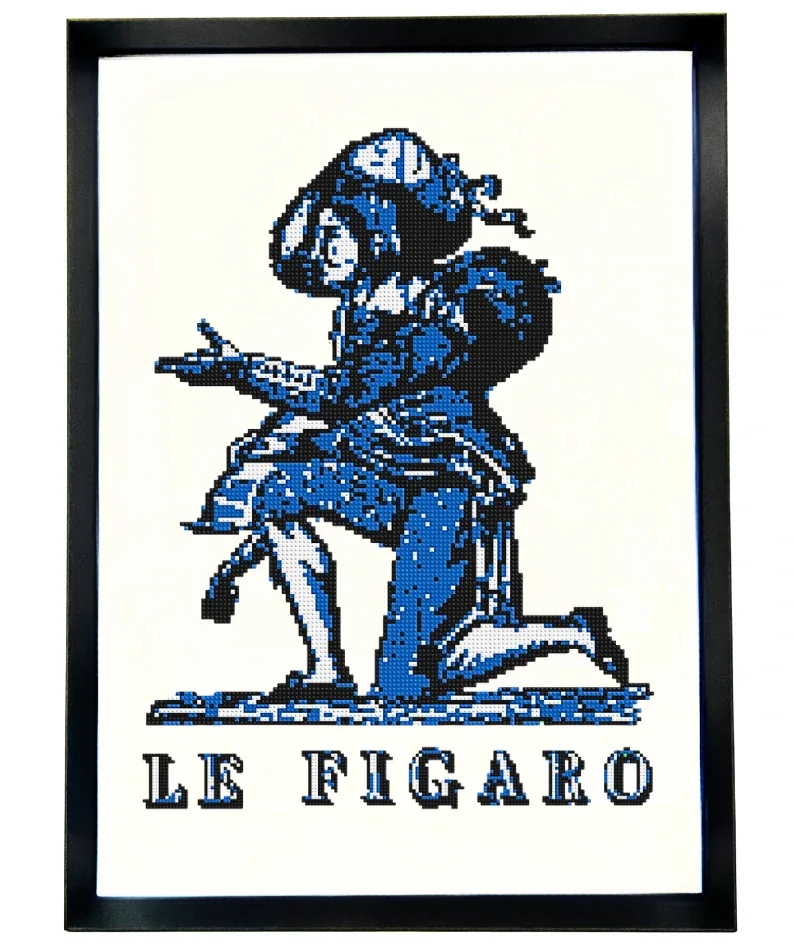
The artwork
Some ideas travel across centuries without losing their power. The freedom to think, question and challenge is among them. With Circulation of Ideas, I wanted to give form to this invisible movement: ideas passing from one person to another, from one era to the next, sometimes changing the way we see the world.
I chose to bring together two visual languages: nineteenth-century engraving and contemporary digital imagery. Figaro emerges from a composition of LEGO® bricks, predominantly blue, black and white. From a distance, the image comes together. Up close, it breaks down into individual elements. This process interests me because collective ideas, too, emerge from individual contributions, encounters and disagreements.
On the reverse, a fully functional QR code, also built entirely from LEGO® bricks, extends the artwork beyond its physical presence. Scanning echoes the gesture of turning a page. The viewer enters a digital space where the image becomes a gateway to content.
Yet this constant circulation has another side. Information can now travel around the world in seconds, without its accuracy necessarily being established. Circulation of Ideas explores the tension between the freedom to communicate and the responsibility carried by every statement we share.
Presented in a black aluminium frame, the artwork brings together the permanence of the constructed object and the ceaseless movement of information. One can be touched; the other travels. Together, they tell the story of our time.
Figaro
Before becoming the name of a newspaper, Figaro was a theatrical character. Created by Beaumarchais in the eighteenth century, he stood out for his intelligence, irreverence and refusal to submit unquestioningly to authority.
Figaro is no conventional hero. He holds neither a prestigious title nor institutional power. His strength lies in words. He observes, mocks, challenges privilege and dares to question a social order many considered unchangeable.
That independent spirit resonates throughout the history of the French press. In 1826, the newspaper Le Figaro took its name from Beaumarchais’s character, making his critical wit an enduring reference.
Two centuries later, the means of communication have changed radically. Printed newspapers coexist with digital platforms and social networks. Yet the essential questions remain: who speaks? Who informs? Who verifies? And what responsibility belongs to those who pass information on?
This continuity is what interests me about Figaro. Behind a silhouette from another century lies a contemporary question: how can we protect freedom of expression without abandoning our commitment to truth?
Technical details
- Dimensions: 59.1 × 47.2 × 2 in
- Weight: 26.5 lb
Similar artworks
- Goldorak — Together We Stand
- Goldorak — Forever
- Goldorak — Blue Legacy
- Sean Connery — The Original Bond
- Roger Moore — The Art of Cool
- Mario — Always in Play
Enquire about this artwork · The whole collection · Behind the bricks: the approach and the QR code